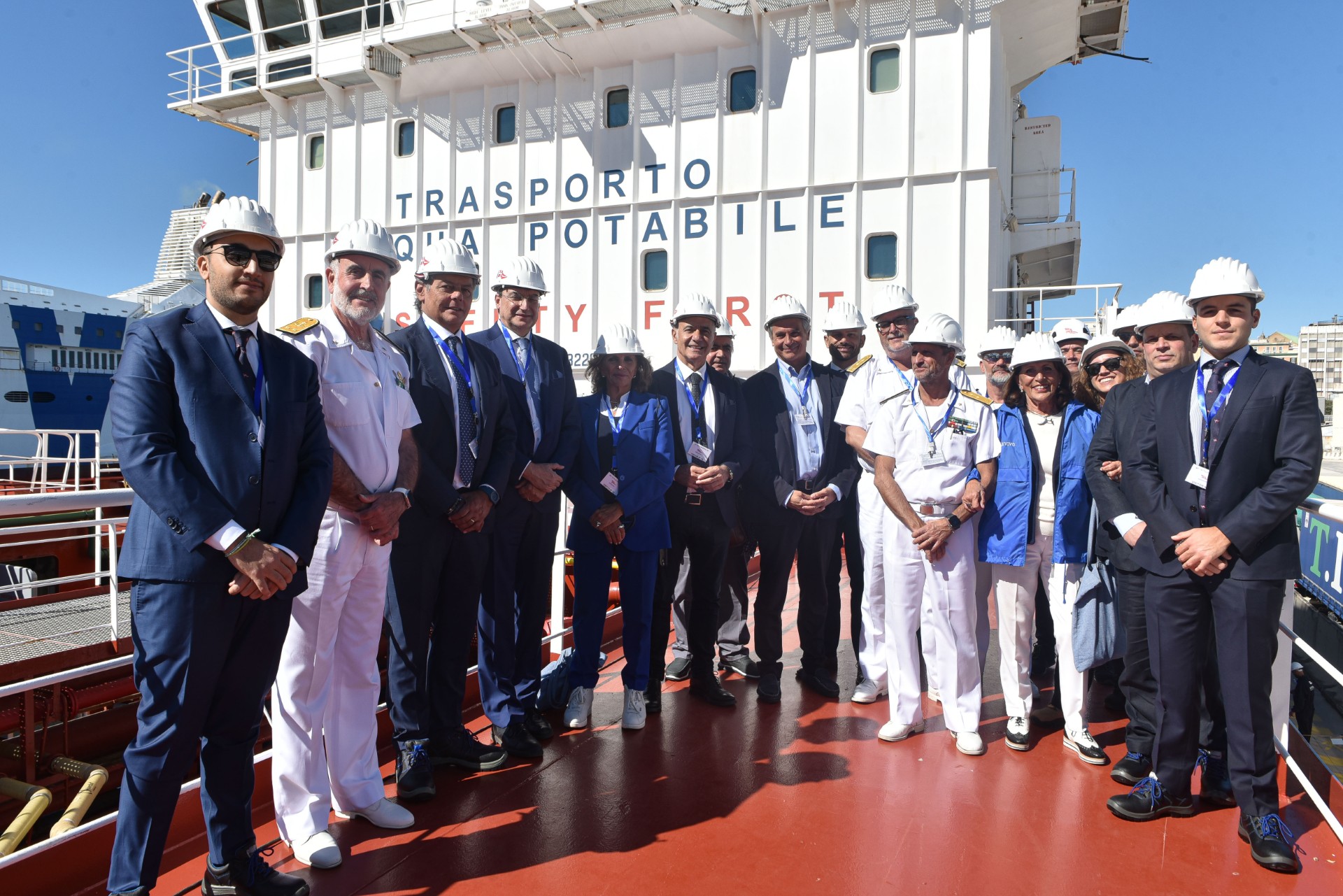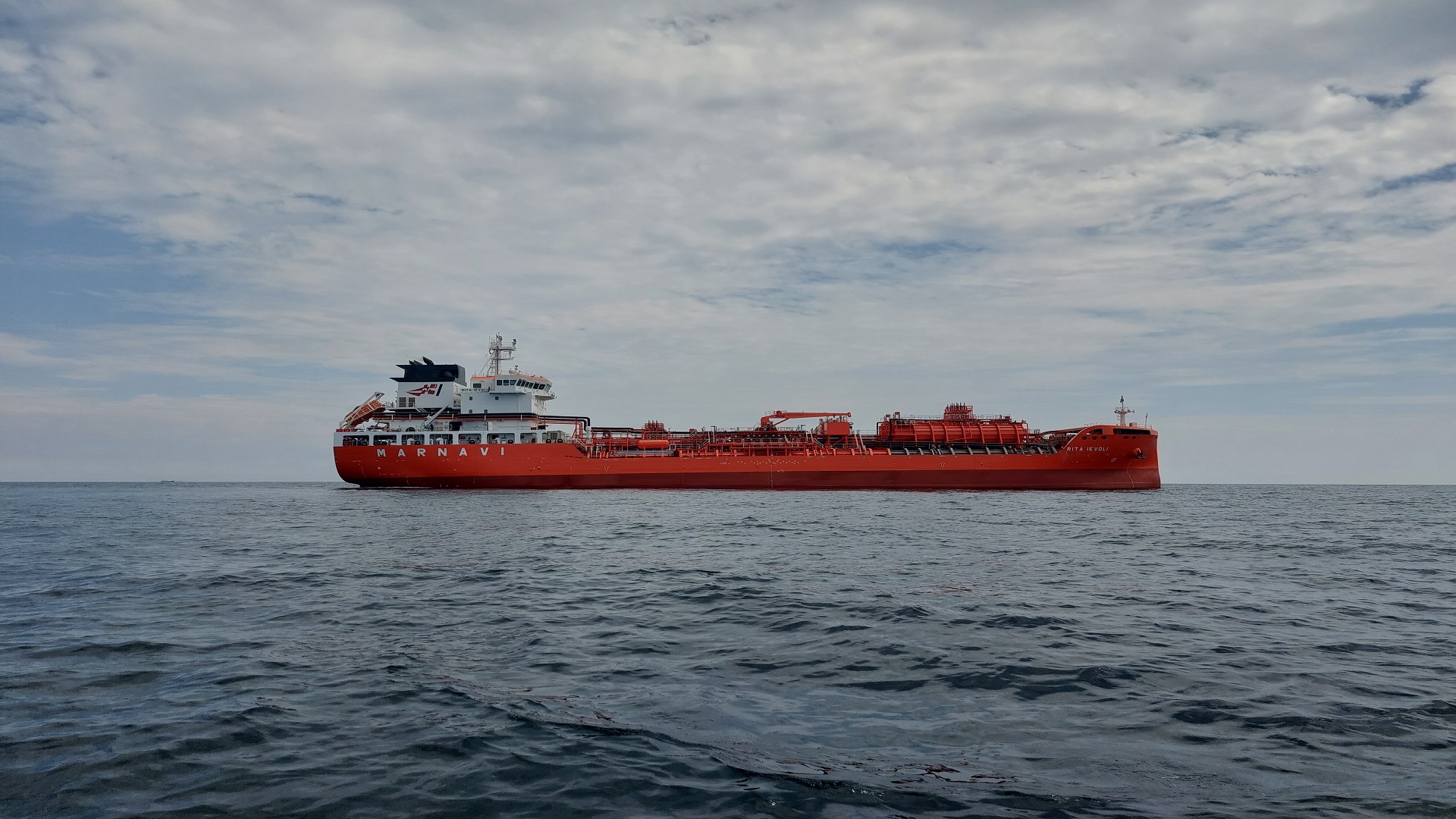


(Naples, October 7, 2025) The climate crisis demands urgent yet sustainable solutions to ensure access to high-quality drinking water, especially in minor islands and archipelagos. Fondazione UniVerde and Fondazione Marevivo, which have for years promoted public debate on the right to drinking water and the protection of the sea, organized an official visit yesterday, October 6, together with SOS Terra, to the mobile marine desalination plant built by Marnavi.
The official delegation, composed of: Brig. Gen. Massimiliano Conti (Deputy Head of Cabinet of the Ministry of the Environment and Energy Security), Adm. Insp. (CP) Vincenzo Leone (Deputy General Commander of the Italian Coast Guard); Adm. Insp. Pierpaolo Budri (Chief of Staff of the Navy Logistics Command), Rear Admiral (CP) Gaetano Angora (Maritime Director of Campania and Commander of the Port of Naples), Alfonso Pecoraro Scanio (President of Fondazione UniVerde), Rosalba Giugni (President of Marevivo), Valerio Rossi Albertini (Atomic-Molecular Physicist at the CNR, Professor at the University of Rome Tor Vergata and television science communicator), Carmen Di Penta (General Director of Marevivo), Giuseppe Di Duca (Director of Fondazione UniVerde and Board of Directors of SOS Terra ETS), was accompanied by a delegation from Marnavi who, during the visit to the plant, illustrated the various process stages to obtain high-quality, safe water with low environmental impact.
Alfonso Pecoraro Scanio (President of Fondazione UniVerde): “The mobile marine desalination plant offers the most sustainable and effective solution, especially for minor islands and archipelagos, as it is capable of guaranteeing a constant supply of high-quality drinking water, fully responding to the citizens’ right to benefit from water resources that are safe from a health perspective and remineralized according to current regulations. In a national context characterized by increasing water stress and supply difficulties, this Italian innovation presents itself as an extremely flexible, modular, and efficient response. The adoption of ship-based desalination is crucial where it is fundamental to avoid the proliferation of fixed desalination plants that are oversized due to high-season needs, or pseudo-removable ones passed off as mobile. Land-based infrastructures have a significant landscape impact, are highly energy-intensive, and are harmful to coastal and marine ecosystems. This is a choice of common sense and environmental responsibility. Scientific research, in fact, has repeatedly highlighted that high-concentration brine discharges produced by fixed plants represent a serious threat to habitats and biodiversity, especially for the protection of our pristine Marine Protected Areas. This is the meaning of today’s initiative and the appeal we address to the Institutions for effective regulatory action in the sector, aimed at promoting Made in Italy technological innovation, already supported by European research projects.”
Rosalba Giugni (President of Marevivo): “Given the importance of regulating this matter effectively, we regret to note that the SalvaMare Law is still a dead letter awaiting the implementing decrees, including the one relating to Art. 12, which establishes stringent criteria and environmental controls on desalination plants, testifying to the fact that the legislator’s intent in regulating such plants was to protect the marine and coastal environment.
Without specific implementing decrees, the law risks losing its effectiveness entirely. Furthermore, the Drought Decree worsens the current framework by allowing exemptions from the EIA obligation for desalination plants. Ship-based desalination allows for the overcoming of critical issues; promoting this type of plant, considering their almost zero environmental impact, is an important initiative that represents a valid solution in the direction repeatedly advocated by Marevivo.”
Brig. Gen. Massimiliano Conti (Deputy Head of Cabinet of the Ministry of the Environment and Energy Security): “Water security is a national priority. We operate in line with the National Plan for Adaptation to Climate Change and the measures of the PNRR – Mission 2, Component 4 to protect water resources, within a governance framework that includes the Control Room for the water crisis. In this process, technological solutions must be integrated into the water cycle: energy efficiency, use of renewables, reduction of leaks, water reuse, and transparent monitoring remain our guiding criteria.
The mobile marine desalination project – developed by Italian entities and implemented on a dedicated naval unit – proposes offshore production with the release of concentrate in deep waters and dilution during navigation, reducing the impact on soil and landscape and allowing for rapid commissioning in emergencies. The flexibility of the ship-plant setup allows for serving multiple islands with economies of scale, while the procedures carried out under the supervision of the Italian Naval Register have defined a new class of units for the production and transport of drinking water. These aspects are consistent with our objectives: maximum environmental compatibility, water quality for human use, and improvement of energy efficiency (with an expected result of up to +30%).”
Adm. Insp. (CP) Vincenzo Leone (Deputy General Commander of the Italian Coast Guard): “The proposal for a mobile marine desalination plant is an extraordinarily winning one. As the Coast Guard, we will monitor the use of this innovative unit. We find the operation very interesting and, as we do daily, we will support shipowners and coastal communities. We are well aware of how traditional desalination plants, the fixed land-based ones, produce emissions and environmental impacts that are not good for the environment. This technology, on the contrary, offers a brilliant solution: it acquires clean water on the high seas, desalinates it, and releases the brine in the open sea, thus avoiding concentration and environmental impact on the coasts.”
Adm. Insp. Pierpaolo Budri (Chief of Staff of the Navy Logistics Command): “The issue of water supply for minor islands has always been one of the institutional tasks of the Defense which, through the Navy, has for years ensured supply with its own water-carrying units, guaranteeing an essential service to local communities. Today, faced with the new challenges posed by the climate crisis, it is fundamental to combine this mission with innovative technological solutions capable of uniting efficiency and environmental sustainability. The Armed Force is committed to this path through the use of low-environmental-impact ships and the progressive energy redevelopment of its land-based infrastructures, with the installation of photovoltaic plants and high-efficiency systems. The Defense, in close collaboration with institutions, research bodies, and industrial entities, intends to continue contributing actively to the development of solutions that respect the marine environment and serve island and coastal communities, contributing to the protection of the sea and the sustainable progress of the country.”
Valerio Rossi Albertini (Senior Researcher at the CNR and television science communicator): “The mobile marine desalination plant is an essential resource, especially under a climate change regime. We have already faced long periods of drought and we know that small islands and archipelagos need easy supplies and high-quality drinking water. The crucial problem with fixed land-based desalination plants is the brine: the high salt concentration of the residue, which coastal biodiversity cannot survive. The desalination ship offers a right and intelligent solution to overcome this obstacle for two main reasons. First, progressive desalination, meaning the extraction of the water resource from the sea can be gradual and controlled, reducing the overall impact. Second, the dispersion of brine on the high seas, which is released along the navigation route. In this way, the salt concentration of the residue will be only slightly higher than that of the sea itself, effectively zeroing environmental impacts and protecting aquatic species.”
Traditional fixed desalination systems, with high energy consumption and a strong impact on coastal ecosystems, are now anachronistic in Marine Protected Areas, minor islands, and archipelagos. The choice to favor a ship with an onboard desalination plant not only protects habitats and marine biodiversity but also offers a modular, pragmatic, and forward-looking solution for water security plans, especially during the tourist season.
The Italian technology of the mobile marine desalination plant, designed and built by Marnavi, represents the fastest, safest, and most economically advantageous response to these challenges. The advantages are numerous:
- reduction of environmental impact: unlike land-based plants, which consume soil and discharge concentrated brine near the coast and, quite surrealistically, a short distance from the intake point of the water to be purified, the mobile desalination plant operates in the open sea; it takes water from the depths, where it is cleaner and therefore easier to purify also in terms of the use of chemical-physical reagents, and gradually disperses the brine during navigation, utilizing the force of the propeller to avoid its concentration in a single discharge point, significantly reducing coastal pollution;
- economic and operational efficiency: this technology allows for an enormous reduction in construction costs and times, and significantly contains maintenance costs as well as ordinary operating costs, compared to a land-based plant that must be powered with large amounts of energy. The mobile marine desalination plant also offers unparalleled operational flexibility. The maximum performance is the use of this technology in archipelagos where, instead of as many plants as there are habitable islands, a single mobile desalination plant would suffice, sized according to the needs of the population present and the period, even in case of emergency;
- water quality and safety: the water produced is of high quality, remineralized according to current regulations, and constantly monitored by specialized personnel on board. The ship is also equipped with systems capable of immediately stopping production in case of anomalies. Finally, a research agreement with the Istituto Superiore di Sanità ensures the maximum safety of the water produced by the mobile marine desalination plant for human consumption.
This innovative type of Made in Italy plant, already operational, represents a tangible example of how Italian technological innovation can combine effectiveness, sustainability, and protection of the coastal and marine environmental heritage, offering a safe solution from a health perspective and a low-impact one for island communities. An alternative with technological and scientific value recognized in 2017 by the then Ministry of Economic Development and the CNR.
In particular, the CNR’s preliminary report for the Horizon 2020 – PON 2014/2020 Call states that “the quality of the project is high both with reference to technical aspects and the level of innovation proposed and expected results” and that, among other things, “desalination while in motion would allow for the limitation of certain impacts typical of plants located on the mainland or on offshore platforms.” A report that allowed the MiSE to admit the project, carried out in collaboration with another leading company in the sector, to the benefits of the European Commission’s funding instrument for scientific research and innovation.
Fondazione UniVerde Press Office